

On Thursday in Huntsville, the deputy commander of NORTHCOM was asked whether he could defend against a swarm of drones launched inside the United States.
His answer was one word. “No.”
Lt. Gen. Joseph Jarrard went on to explain that the command lacks the sensors to see such an attack coming, and the effectors to stop it once it does. “We are ill-equipped right now to handle something like that.”

Most of the coverage ran with the sensor half of that sentence. I keep coming back to the effector half, because that is where the procurement question actually lives, and it is the half that closes for industry responses this Wednesday.
The magazine problem
Here is the issue with defending against a swarm. You cannot fire a premium interceptor at fifty airframes that cost $500 each. The economics collapse on the first volley. The existing magazine was built for aircraft and cruise missiles, and a swarm attacks the cost column, not the capability column.
The Army seems to have understood this, because it is not building one interceptor. It looks to me like it is building a tiered magazine.
At the top sits NGSRI, the Stinger replacement. Lockheed and Raytheon have both flight tested designs this year. A premium round for premium targets.
At the bottom sits something most people have never heard of: NGCM, the Next Generation Counter-sUAS Missile. The Army’s sources-sought notice went out on August 4. Under $150,000 a round. Must fit Raytheon’s existing Coyote launcher. Fixed-site and mobile variants, both specified with electro-optical and infrared sensors. At least 5,000 missiles. Responses close August 20.
At 5,000 rounds under $150K, that is a programme floor somewhere around $750 million, for the cheap tier alone.
There is also a structural change underneath it that I think matters more than any single solicitation. Army Secretary Driscoll said in May that the Army intends to break interceptors into subsegments, buying seekers, motors and fire control separately, with component offerings needing only TRL 4 maturity. Historically a component maker reached a missile programme through a prime. Under this model the Army knocks on the component maker’s door directly. That is a different market structure, and a much shorter path.
What the bottom tier needs to see with
Think about what a close in, low cost kinetic system actually requires at the sensing layer.
It has to watch every direction at once, because an FPV drone does not announce its bearing. It has to run continuously, because the engagement window is seconds. And near cities and critical infrastructure it probably has to be passive, because actively radiating RF around civilian airspace ranges from complicated to legally fraught. A sensor that emits nothing and simply stares is the one that fits everywhere.
That is a fairly specific product description. Which brings me to the thing hiding in plain sight.
The LinkedIn post
About a month ago, LightPath Technologies announced a memorandum of understanding with Picket Defense Systems, a small US counter-UXS company. No press release. No wire service. A LinkedIn post to roughly six thousand followers.
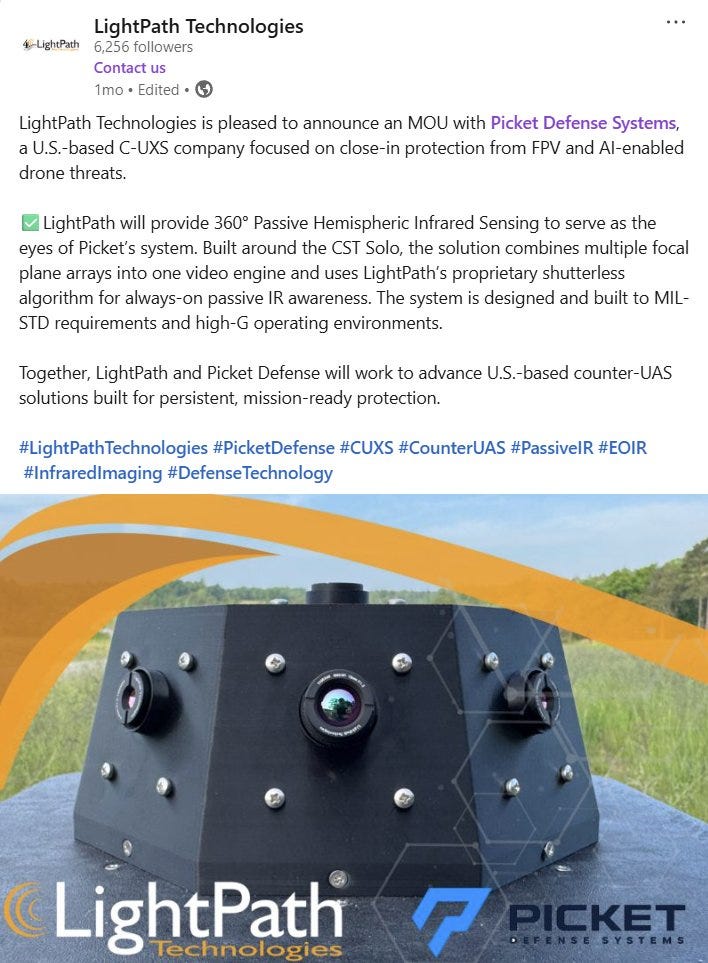
Picket’s repost supplied the sentence that matters, describing the deal as “integrating LightPath’s 360° passive hemispheric infrared sensing technology into our Inferno RTC platform” for close-in protection against FPV and AI-enabled drone threats.
Picket’s Inferno RTC is a close-in kinetic counter-drone system, and it was selected for a DIU Phase II effort earlier this year, with live testing in front of DoD evaluators. Interceptor at the centre, passive infrared array watching the whole sky around it.
And the array itself is now a catalogue product. LightPath’s CST Omni, which appeared on the company’s August investor deck, is described as a multi-sensor architecture using multiple 640 x 480 infrared cores behind the company’s BlackDiamond lenses, shutterless, fully passive, configurable from wide-area coverage down to what their own marketing calls danger-close awareness. Picket reposted the product launch and captioned it advanced threat sensing for kinetic C-UAS.
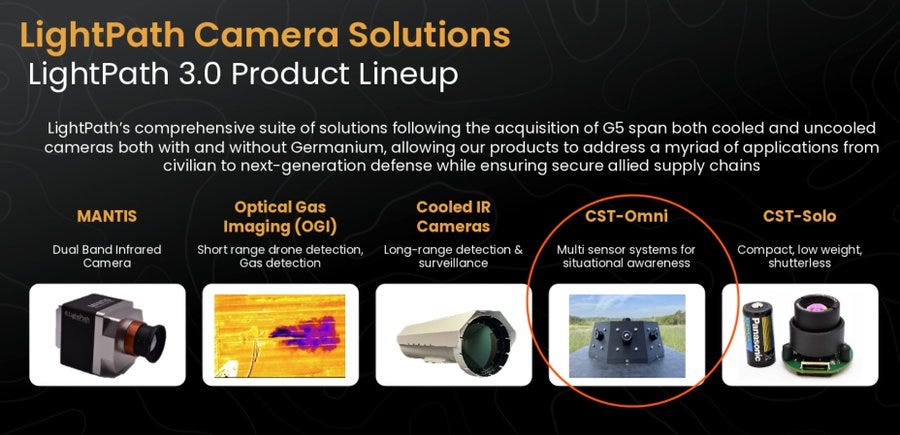
So the chain, entirely from public posts by the two companies themselves: the Army’s cheapest interceptor tier specifies EO/IR sensing at fixed sites. A DIU-selected close-in kinetic system exists. Its 360-degree passive sensing layer is built by a listed optics company in Orlando, photographed, dual-branded, and already in the product lineup.
Why nobody saw it
This is the part I find genuinely interesting as an exercise in how information moves.
LightPath’s CEO has said the company will no longer issue press releases for orders below $5 million. Federal contract data carries a mandatory 90-day publication delay, so anything awarded since roughly mid-May is not yet visible in any database. And the Army’s new component-level buying model makes individual awards smaller at exactly the moment it makes them more numerous.
Put those together and the order flow in this corner of the market is going dark precisely as it accelerates. The announcements have not stopped. They have moved to LinkedIn posts with a few hundred views. The only reliable instrument left is the product-group revenue table in the company’s filings, and the next one prints September 10.
What I am watching from here: whether NGCM moves from sources-sought to solicitation after Wednesday, whether DIU publishes Phase II results, and what the September 10 product-group table says about the order flow nobody can currently see.
Caveat that I am an investor reading public documents, not an engineer or a procurement officer, so treat the joins between these dots as my working assumptions rather than anyone’s confirmation.
Disclosure: I am long LPTH. Nothing here is financial advice or a recommendation; it is my own research process, shared. Do your own work.